Workforce Success
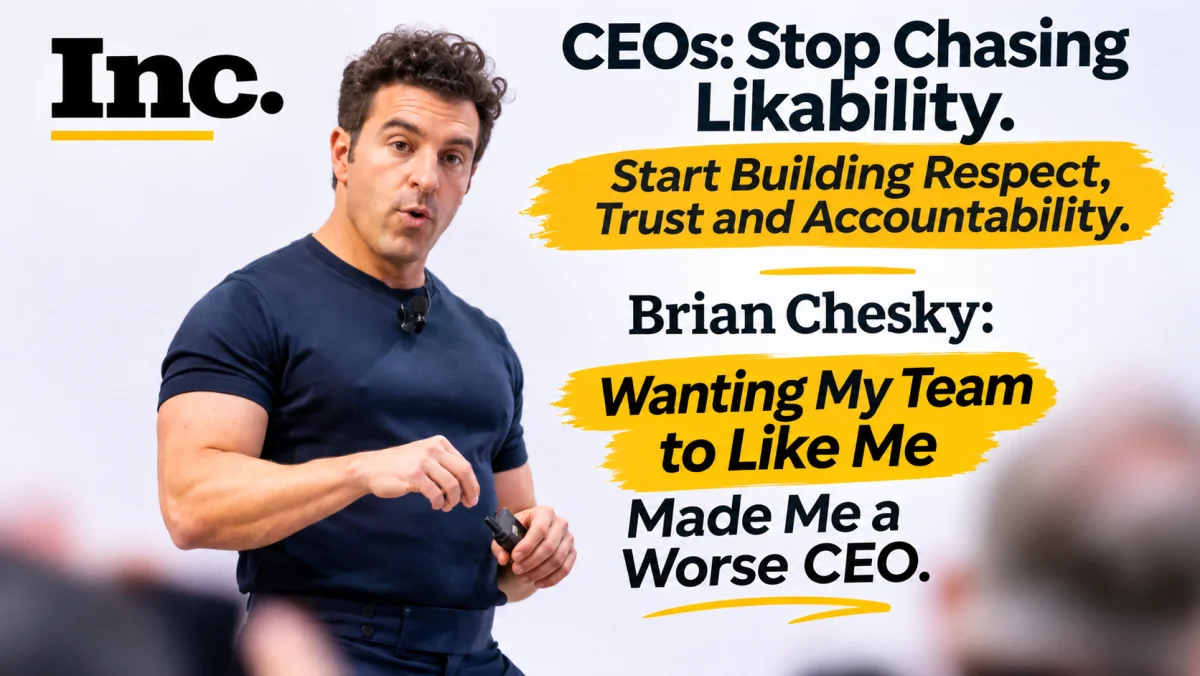
CEOs: Stop Chasing Likability. Start Building Respect, Trust, and Accountability.
By Deo Mwano
Written by Deo Mwano, CEO and Managing Principal of Deo Mwano Consultancy
Leadership reflections on Brian Chesky’s admission that wanting his employees to like him made him a less effective CEO.
In a recent Inc. Magazine article by Chris Morris, Brian Chesky, co-founder and CEO of Airbnb, reflected on how his desire to be liked by his team ultimately made him a worse CEO.
“I think I was pretty much naturally a great founder, and I was naturally a terrible CEO,” Chesky said in a recent interview.
His reflection raises an important leadership question: Should CEOs focus on being liked by their employees, or should they focus on earning their respect?
Through my work at Deo Mwano Consultancy (DMC), supporting senior leadership teams while also engaging directly with frontline, associate-level, and junior employees, I have seen how critical this distinction can be to organizational success.
Successful organizations require a balance between leadership effectiveness, employee engagement, accountability, and performance. Understanding what drives employees to do their best work is just as important as understanding how they perceive senior leadership.
Being liked and being respected are two different things. While they are not mutually exclusive, they do not necessarily produce the same outcomes.
The CEO’s Responsibility Goes Beyond Being Liked
A CEO’s primary responsibility is to lead people, establish direction, and guide the organization toward its priorities and desired outcomes.
This requires understanding the organization’s strategic priorities, connecting them to the bottom line, and ensuring employees understand how their individual responsibilities contribute to organizational success.
Equally important is understanding how employees interpret those priorities and whether they have the resources, support, and clarity necessary to perform effectively.
A CEO can be well-liked and still lead an underperforming organization. Employees may genuinely enjoy working with their CEO while remaining unclear about expectations, disconnected from organizational priorities, or insufficiently accountable for their performance.
Likability alone does not produce productivity, trust, or organizational success.
What Is Driving the Desire to Be Liked?
Before dismissing likability as a leadership weakness, I believe it is important to examine what drives a CEO’s desire to be liked.
What does being liked mean to that leader? What are they hoping to achieve?
Is the desire rooted in an internal need for validation or acceptance? Does the CEO associate being liked with being an effective leader?
Or is the desire rooted in something more altruistic, such as wanting employees to feel valued, supported, and genuinely connected to their leadership?
These distinctions matter.
A CEO who seeks approval to satisfy a personal need may avoid difficult conversations, hesitate to make unpopular decisions, or compromise expectations to preserve relationships.
On the other hand, a CEO who genuinely cares about employees’ experiences may build strong relationships while maintaining high standards and accountability.
The issue is not necessarily whether employees like their CEO. The issue is whether the pursuit of likability compromises the CEO’s ability to lead effectively.
This is why I place greater emphasis on earning respect rather than pursuing likability.
Respect Requires Accountability, Even When Conversations Are Difficult
Running a business is challenging. Leadership involves navigating uncertainty, setbacks, competing priorities, and periods of significant pressure.
A CEO must be able to motivate, inspire, and develop employees while also encouraging them to take action and deliver results.
Sometimes that requires pushing people beyond their comfort zones, raising expectations, and addressing performance gaps.
Effective leadership means recognizing where employees are succeeding while also identifying where they are falling short.
An employee who is not meeting expectations may not appreciate being challenged to improve. They may disagree with the feedback or feel uncomfortable with the accountability being introduced.
But avoiding that conversation to preserve likability can ultimately hurt the employee, the team, and the organization.
The CEO’s responsibility is not simply to point out poor performance. It is to help employees understand the connection between their actions, their responsibilities, and the organization’s priorities.
This is where I often see leaders struggle.
They identify a performance problem but fail to clearly explain why it matters, how it affects the organization, or what improvement should look like.
Accountability without clarity can create frustration and resentment.
Effective accountability requires leaders to:
- Clearly identify the performance or behavioral concern.
- Explain how the issue affects the team, organizational priorities, or business outcomes.
- Establish specific expectations for improvement.
- Provide appropriate tools, guidance, coaching, and resources.
- Set measurable goals and realistic timelines.
- Follow through consistently and document progress.
When employees understand the purpose behind expectations, they are better positioned to take ownership of their performance.
You Can Be Assertive and Still Be Respectful
Being an effective CEO does not require being intimidating, dismissive, or unnecessarily harsh.
Leaders can be assertive while demonstrating empathy, respect, and genuine concern for their employees.
The difference often comes down to how expectations are communicated and reinforced.
Employees should not have to guess what matters to their CEO, what success looks like, or how they will be evaluated.
Leadership expectations should be consistent, clearly communicated, and connected to measurable outcomes.
One practice I encourage leaders to adopt is designing an intentional working alliance with their teams.
This means establishing a shared understanding of how the leader and employees will work together, especially when circumstances become challenging.
CEOs should communicate their non-negotiables, leadership philosophy, expectations for performance, and approach to navigating difficulties.
They should also explain how they intend to show up when things are not going well.
Will they be direct? Will they ask difficult questions? How will they approach mistakes, disagreements, or missed expectations? What support can employees expect, and what responsibilities must employees take ownership of?
These conversations help normalize the reality that challenges are part of organizational life.
They also create a foundation for mutual respect and accountability before problems arise.
Never Assume Your Employees Understand Your Intentions
One of the most common challenges I encounter when coaching leaders is the assumption that employees already understand their intentions.
I often hear leaders say things like:
- “I thought they understood why I was asking them to do that.”
- “I assumed they knew what I expected.”
- “I didn’t think I needed to explain it because it seemed obvious.”
These assumptions can create significant disconnects between leadership and employees.
What is obvious to a CEO is not necessarily obvious to the people responsible for carrying out the work.
Leaders operate with access to information, pressures, and organizational considerations that employees may never see.
Without intentional communication, employees may interpret leadership decisions differently from how they were intended.
This can influence trust, motivation, engagement, and performance.
I encourage leaders to consistently explain their intentions and connect their expectations to the organization’s priorities.
Employees do not need to agree with every decision. However, they should understand the reasoning behind important decisions, what is expected of them, and how their contributions influence the organization’s success.
Clarity does not guarantee agreement, but it creates a stronger foundation for trust and respect.
Meet Your Employees Where They Are, Not Where You Assume They Should Be
Earning respect requires more than communicating expectations. It also requires understanding the experiences and perspectives of the people you lead.
This is why engaging employees at different levels of an organization is so important.
Senior leaders often have a very different understanding of organizational priorities than the employees responsible for executing them.
When leaders take the time to understand employees’ experiences, barriers, motivations, and available resources, they are better positioned to create conditions that support strong performance.
Meeting employees where they are does not mean lowering standards.
It means understanding what they need to meet those standards and creating the conditions for them to succeed.
It also means recognizing when employees have the tools and support they need but are still not meeting expectations. At that point, accountability becomes essential.
Final Reflection: Respect Is Earned Through Consistency
A CEO does not need to choose between being respected and being compassionate.
The strongest leaders understand how to balance both.
They communicate their intentions, establish clear expectations, recognize strong performance, address shortcomings, and remain consistent in how they treat people.
They also recognize that leadership decisions will not always make everyone happy.
The goal should not be to become the most liked person in the organization. The goal should be to build an environment where employees understand the mission, trust the leadership process, feel supported, and take ownership of delivering results.
Being liked may make leadership feel more comfortable. Being respected, trusted, and consistent makes leadership more effective.
At Deo Mwano Consultancy, much of our work focuses on helping organizations understand the relationship between leadership practices, employee experiences, accountability, and organizational performance.
One lesson continues to stand out: Leaders earn lasting respect not by seeking approval, but by demonstrating clarity, fairness, consistency, and a commitment to helping people succeed.
And when the stakes are high, those qualities matter far more than popularity.